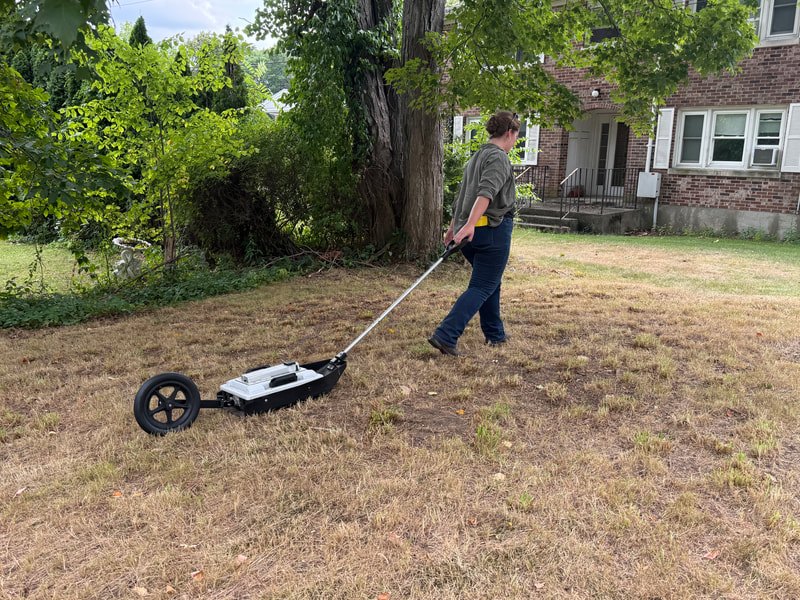
Archaeologists tested ground-penetrating radar at Canton's Gridley Cemetery on Friday, Aug. 28, a preliminary step toward a full survey of the burial ground's hidden graves planned for October.
John M. Steinberg, a research scientist with the Fiske Center for Archaeological Research at UMass Boston, spent about an hour at the 2,304-square-foot burial ground with a graduate student, testing whether the radar technology could detect what lies beneath the surface.
The Canton Historical Commission is directing the work through a Community Preservation Grant.
The cemetery, established in 1764, sits off Washington Street. It once held the remains of Colonel Richard Gridley, whom the Canton Historical Society describes as the Continental Army's first chief engineer. Gridley laid out fortifications for the Battle of Bunker Hill and designed the defenses on Dorchester Heights that forced the British out of Boston in 1776. His remains were moved to Canton Corner Cemetery in 1876. A Quincy Granite monument there bears an inscription attributed to George Washington: "I know of no man better fitted to be Chief Engineer than General Gridley."
Much of the burial ground's history has been lost. Gravestones have disappeared or sunk below ground, individual grave locations are largely unknown, and the cemetery's original layout is no longer visible, according to the Canton Historical Society.
The results looked promising. Steinberg evaluated ground conditions and determined the radar is likely to yield useful archaeological data at the site, the society said.
Ground-penetrating radar, or GPR, lets researchers detect subsurface patterns without digging. The society called the non-invasive approach especially valuable for a historic cemetery where protecting the site and respecting those buried there are priorities.
If plans hold, a comprehensive GPR survey will follow in October. That full investigation would seek to locate and map graves, estimate the number of burials, identify buried headstones or other features, and reconstruct how the cemetery was originally organized.
The radar work is the first phase of a broader Gridley Cemetery Preservation Project. Plans also call for historically appropriate fencing and interpretive signage, but the commission wants the subsurface survey completed first so fence posts and sign foundations do not disturb graves or other archaeological resources.
The National Park Service notes Gridley was appointed chief engineer on April 26, 1775, shortly after the battles at Lexington and Concord. He was wounded at Bunker Hill. He died in 1796 at age 86.
The commission has not announced a public presentation tied to the project. The next milestone is the full October survey.